
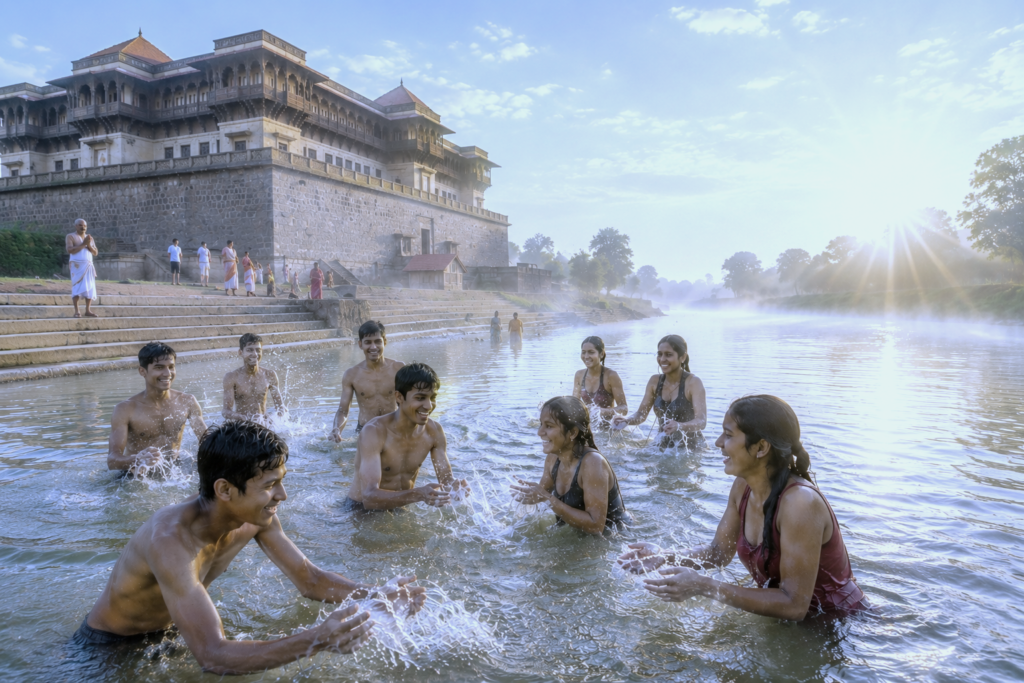
The Holy Dip
for Wellbeing
During the dawn is a very beautiful conducive combination of helpful early morning sun rays and the water is cool due to absence of sun during whole night and still not yet warm as the sun is just arrived.
What does this combination do how does the beautiful morning set within you to keep up your wellbeing ?
Early morning dip in river is not because we could not build bathrooms, it has a lot of Physiological and Spiritual significance by all means towards your wellbeing.
Let us understand it clearly.
Taking repeated dips in cold water during early morning sunlight may affect the body through a combination of cold exposure, breath control, nervous system activation, and circadian rhythm (the body’s internal 24-hour biological timing system) regulation.
When the body suddenly enters cold water, it experiences an immediate “cold shock response.” This temporarily increases stress hormones such as adrenaline and cortisol, raises alertness, and activates the sympathetic nervous system — the body’s “fight or flight” response.
At the same time, dipping underwater naturally causes brief breath holding. Cold water on the face and upper body, combined with breath retention, activates part of the mammalian dive reflex — a physiological response seen in humans and other mammals.
What is Vagus nerve? and Effect of stimulating vagus nerve.
The vagus nerve is one of the main nerves connecting the brain to the body.
It runs from the brainstem down through:
- the face,
- throat,
- heart,
- lungs,
- stomach,
- and intestines.
It is a major part of the parasympathetic nervous system, which helps the body:
- calm down after stress,
- regulate breathing,
- slow heart rate,
- support digestion,
- and maintain internal balance.
The word “vagus” comes from Latin meaning “wandering” because the nerve travels through many organs in the body.
The vagus nerve is one of the body’s major integrative communication pathways, linking the brain with several vital organs and helping regulate internal physiological balance.
What does the vagus nerve do?
It constantly sends signals between the brain and organs to regulate automatic functions such as:
- heart rate,
- breathing,
- digestion,
- swallowing,
- inflammation,
- and stress recovery.
increased Vagal tone
“Increased vagal tone” means the vagus nerve is more actively influencing the body toward a calm, regulated, recovery-oriented state.
The vagus nerve is a major part of the parasympathetic nervous system (“rest and digest” system).
Higher vagal tone is generally associated with:
- better stress regulation,
- calmer heart activity,
- improved emotional regulation,
- better recovery after stress,
- and more flexible switching between alertness and relaxation.
Physiologically, increased vagal tone can involve:
- lower resting heart rate,
- faster calming after stress,
- more stable breathing patterns,
- improved heart rate variability (HRV),
- and reduced excessive sympathetic (“fight or flight”) dominance.
How cold water + breath holding may affect it
Cold facial water exposure and controlled breathing can activate reflexes connected to the vagus nerve.
Typical sequence:
- Cold dip → stress activation.
- Breath hold → autonomic adjustment.
- Slow exhalation after resurfacing → parasympathetic activation.
- Heart rate may slow afterward.
Repeated practice may improve autonomic flexibility — meaning the body becomes better at returning to calm state after stress.
Important clarification
“Increased vagal tone” does not mean:
- permanently relaxed,
- emotionally numb,
- or low energy.
Healthy vagal tone means:
- the nervous system can activate when needed,
- and recover efficiently afterward.
That adaptability is what researchers often associate with resilience and stress regulation.
This reflex stimulates the vagus nerve and activates the parasympathetic nervous system, often called the “rest and digest” system. Parasympathetic activation helps slow the heart rate, regulate breathing, and calm the body after stress.
The sequence during repeated dipping generally looks like this:
- Enter cold water → stress response activates.
- Dip underwater → breath briefly stops.
- Cold water stimulates facial nerves.
- Resurfacing causes slow recovery breathing.
- The body shifts into a calmer parasympathetic state.
This way body learns to come out of stress
Repeating this cycle multiple times creates alternating phases of:
- sympathetic activation (stress/arousal),
followed by - parasympathetic rebound (calming/recovery).
This repeated switching may help improve autonomic nervous system flexibility — meaning the body becomes better at recovering from stress.
Research on cold-water immersion suggests possible effects such as:
- increased alertness,
- temporary mood elevation,
- calmer breathing after resurfacing,
- improved stress resilience over time,
- reduced perceived stress in some individuals,
- and improved autonomic regulation.
What is circadian rhythm ?
The circadian rhythm is the body’s internal 24-hour biological timing system.
It regulates when you naturally:
- feel awake or sleepy,
- release hormones,
- feel hungry,
- digest food,
- change body temperature,
- and perform mental/physical functions.
The main “clock” is located in the brain in an area called the suprachiasmatic nucleus (SCN) inside the hypothalamus.
The strongest controller of this clock is light, especially early morning sunlight entering the eyes.
What happens in a normal circadian rhythm?
Morning
- Cortisol naturally rises (“cortisol awakening response”).
- Body temperature increases.
- Alertness rises.
Daytime
- Energy, digestion, reaction speed, and focus are higher.
Evening
- Light decreases.
- Melatonin production starts rising.
Night
- Body temperature drops.
- Sleep pressure increases.
- Repair and recovery processes become dominant.
Why morning sunlight matters
Early sunlight contains blue wavelengths that signal the brain:
“It is daytime.”
This helps:
- properly time cortisol release,
- suppress melatonin in morning,
- improve alertness,
- and strengthen nighttime sleep later.
Poor circadian alignment (late-night screens, irregular sleep, lack of sunlight) can disrupt:
- sleep quality,
- mood,
- hormone balance,
- metabolism,
- and stress regulation.
So when people expose themselves to:
- sunrise light,
- movement,
- cold water,
- and controlled breathing early in the morning,
they may be strongly reinforcing circadian timing signals in the body.
Morning sunlight further influences the process. Early sunlight helps regulate circadian rhythm (the body’s internal biological clock responsible for sleep, hormone timing, alertness, and recovery cycles).
Morning sunlight:
- supports the natural cortisol awakening response,
- increases daytime alertness,
- and helps regulate nighttime melatonin release.
Because cortisol naturally peaks in the early morning, cold-water dipping at sunrise may interact with an already active hormonal and nervous-system state.
Scientifically, the combined mechanism can be summarized as:
- Early sunlight → circadian and hormonal regulation.
- Cold water → acute stress activation.
- Breath holding + facial cold exposure → vagus nerve and parasympathetic activation.
- Repeated dipping cycles → alternating stress and recovery responses.
The refreshed, calm, mentally clear feeling often reported after repeated cold-water dipping may therefore result from the interaction between:
- cold exposure,
- controlled breathing,
- vagus nerve stimulation,
- parasympathetic rebound,
- and morning circadian signalling.
Conclusion: A Simple act of bathing in river every morning enhances your life maifold time. Doing the act on daily basis tames your body to be free of stress and is the answer to the argument
Stress is inevitable how can one escape it ?
The whole combination is very beautiful relaxing life changing because less stressed and calm person has clarity, makes good decissions and clear visibility of life, is less confused more productive in life.
Isn’t it ?