
NK-KAPPA B Signalling
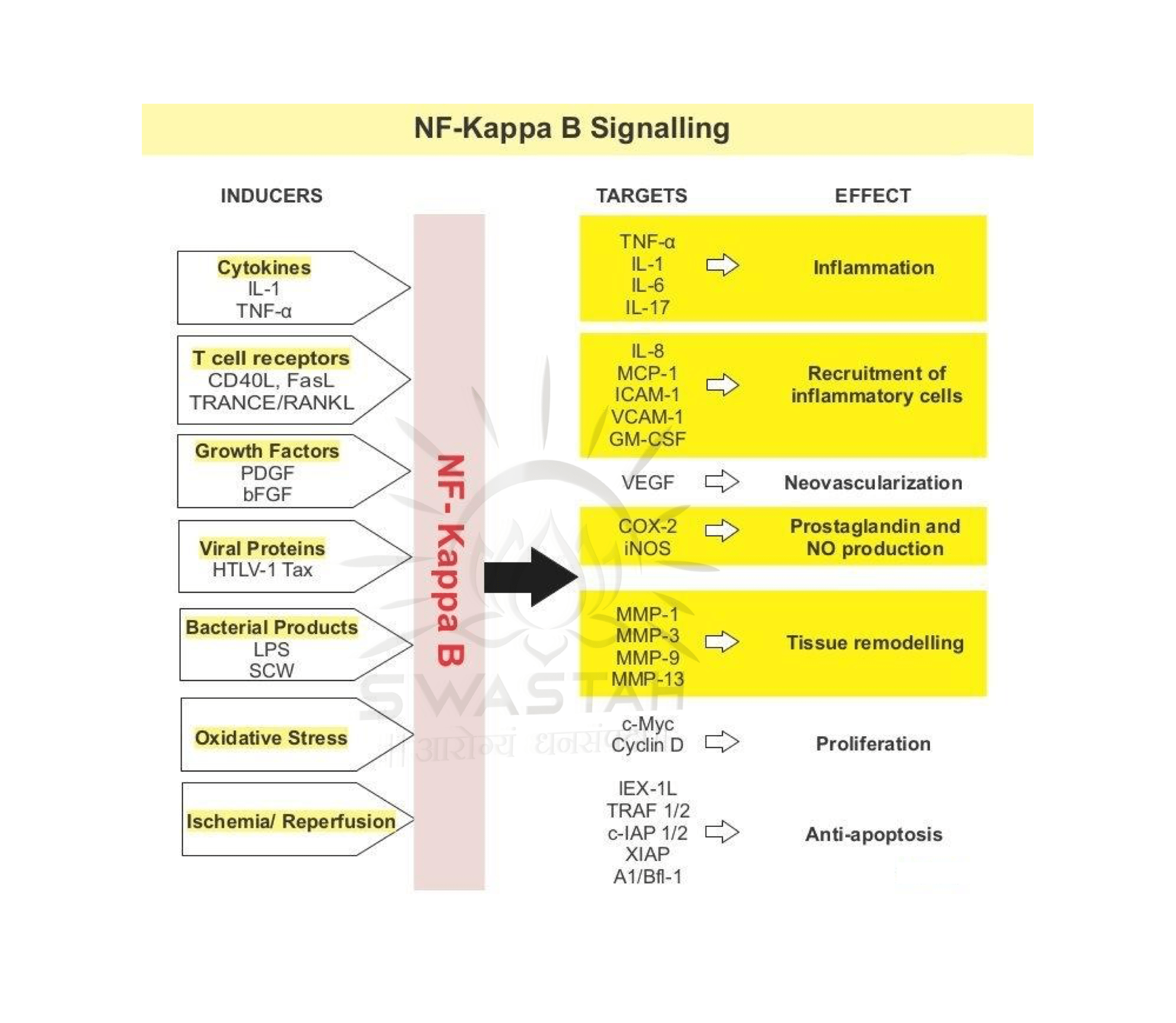
Curcumin (the main bioactive compound in turmeric) suppresses inflammation by inhibiting the NF-κB signalingpathway, which is a master regulator of immune and inflammatory gene expression.
Here’s the mechanism in a clear, step-by-step way:
1) What NF-κB normally does
NF-κB is a transcription factor (a protein that turns genes on).
When activated, it moves into the nucleus and triggers genes for:
• inflammatory cytokines (TNF-α, IL-1, IL-6)
• COX-2 and prostaglandins
• adhesion molecules
• immune and stress responses
It is activated by:
• infection
• oxidative stress
• toxins
• chronic disease states
• obesity and insulin resistance
2) NF-κB “OFF state”
Normally:
• NF-κB stays inactive in the cytoplasm
• It is bound to an inhibitory protein called IκB (Inhibitor of kappa B)
This keeps inflammation under control.
3) NF-κB “ON state” (inflammation begins)
When a trigger occurs:
1. Enzyme IKK (IκB kinase) activates
2. IKK phosphorylates IκB
3. IκB gets degraded
4. NF-κB is released
5. NF-κB enters nucleus
6. Turns ON inflammatory genes
This drives chronic inflammation. Some of the ailments popularly known
• arthritis
• diabetes
• cancer
• gut disorders
• metabolic disease
4) Where curcumin acts
Curcumin blocks NF-κB activation at multiple levels (this is why it’s powerful).
A) Inhibits IKK enzyme
• Prevents phosphorylation of IκB
• NF-κB remains trapped in cytoplasm
B) Prevents IκB degradation
• Stabilizes the inhibitor
• Stops NF-κB release
C) Blocks nuclear translocation
• NF-κB cannot enter nucleus efficiently
D) Suppresses DNA binding
• Even if NF-κB enters nucleus, curcumin reduces its ability to activate genes
E) Reduces upstream triggers
Curcumin lowers:
• ROS (oxidative stress)
• TNF-α signaling
• toll-like receptor activation
So the pathway is shut at multiple checkpoints.
5) Result: Downstream effects
Because NF-κB is central to inflammation, curcumin leads to:
↓ cytokines (IL-6, TNF-α)
•
Reduces Inflammation
↓ COX-2
• ↓ prostaglandins
•
↓ cell proliferation signals
• ↑ apoptosis in abnormal cells
• improved insulin sensitivity
• gut lining protection
6) Why this matters clinically
NF-κB overactivation is a root mechanism in:
Condition
Role of NF-κB
Effect of Curcumin
Arthritis
joint inflammation
reduces pain & swelling
Diabetes
insulin resistance
improves signaling
Cancer
cell survival & proliferation
promotes apoptosis
GERD/gut disease
mucosal inflammation
restores barrier
Asthma
airway inflammation
reduces cytokines
Autoimmune
immune overactivation
modulates response
7) Key scientific insight
Curcumin is not a single-target drug.
It is a network regulator:
• NF-κB
• STAT3
• COX-2
• LOX
• Nrf2
• AMPK
That’s why it’s called:
“a master anti-inflammatory nutraceutical.”
8) Simple analogy
Think of NF-κB as a fire alarm system.
• Triggers → smoke
• IKK → alarm switch
• NF-κB → fire siren activating firefighters (inflammation)
Curcumin:
• blocks the alarm switch
• prevents siren activation
• calms unnecessary emergency response
But still allows normal immunity.
Here’s a clear clinical comparison of curcumin vs NSAIDs vs corticosteroids, especially in the context of NF-κB–driven inflammation.
Core mechanism difference
table
Depth of anti-inflammatory action
Curcumin
• Multi-target regulator
• Acts on:
o NF-κB
o STAT3
o COX-2
o LOX
o Nrf2
o AMPK
• Works at root signaling level
NSAIDs
• Single-pathway drugs
• Block:
o COX-1 / COX-2 → ↓ prostaglandins
• Primarily symptom relief:
o pain
o fever
o swelling
Steroids
• Genome-level suppression:
o inhibit inflammatory gene transcription
o suppress T-cell and macrophage activity
• Most powerful class clinically
Curcumin can also Block:
o COX-1 / COX-2 → ↓ prostaglandins
o Provide Primarily symptom relief
inhibit inflammatory gene transcription
o suppress T-cell and macrophage activity
in its own way
• Curcumin has disease-modifying potential
Safety profile
table
Evidence pattern seen clinically
• Curcumin reduces NSAID requirement in arthritis patients
• Comparable pain reduction to ibuprofen in mild–moderate osteoarthritis (in studies)
• Steroids still superior in severe inflammation
Curcumin daily Consumption
• reduce steroid dependence
• prevent relapse
• maintain immune balance
what other pathways does curcumin work on ?
Curcumin is not a single-pathway molecule. It acts on a network of inflammatory, metabolic, oxidative, and immune signaling pathways—
Here are the major pathways beyond NF-κB:
Major molecular pathways curcumin modulates
1) STAT3 pathway
Role: cell survival, tumor growth, chronic inflammation
Curcumin:
• inhibits STAT3 phosphorylation
• reduces IL-6 signaling
• decreases tumor
Clinical relevance:
• cancer biology
• autoimmune inflammation
• metabolic disease
2) Nrf2–Keap1 antioxidant pathway
Role: master regulator of cellular antioxidant defense
Curcumin:
• activates Nrf2
• increases glutathione synthesis
• upregulates SOD, catalase, HO-1
Effect:
• reduces oxidative stress
• protects liver, brain, gut lining
This is one of curcumin’s most important protective mechanisms.
3) MAPK pathway (ERK, JNK, p38)
Role: inflammation, stress signaling, apoptosis
Curcumin:
• suppresses p38 and JNK activation
• reduces inflammatory cytokine release
Used in:
• arthritis
• neuroinflammation
• skin inflammation
4) COX-2 and LOX pathways
Role: prostaglandin and leukotriene production
Curcumin:
• downregulates COX-2 gene expression
• inhibits 5-LOX
Outcome:
• reduces pain mediators
• anti-inflammatory effect similar (but milder) than NSAIDs
5) AMPK pathway
Role: metabolic master switch
Curcumin:
• activates AMPK
• improves insulin sensitivity
• reduces hepatic fat synthesis
Relevance:
• diabetes
• obesity
• fatty liver
6) mTOR pathway
Role: cell growth and proliferation
Curcumin:
inhibits mTOR signaling
Implications:
cancer research
aging biology
metabolic syndrome
7) TLR4 signaling
Role: innate immune activation via microbial signals
Curcumin:
blocks TLR4 activation
reduces endotoxin-driven inflammation
Important in:
gut disease
sepsis research
metabolic inflammation
8) Apoptosis pathways
Curcumin regulates:
Bcl-2
Bax
caspases
Promotes apoptosis in:
abnormal cells
tumor cells
Protects normal cells via antioxidant action.
9) Wnt/β-catenin pathway
Role: cell proliferation, cancer development
Curcumin:
suppresses β-catenin signaling
Studied in:
colon cancer
tissue remodeling
10) PPAR-γ pathway
Role: lipid metabolism, insulin sensitivity
Curcumin:
activates PPAR-γ
Effects:
improves glucose metabolism
reduces adipose inflammation
Systems-level view
Curcumin acts on four biological axes:
A) Inflammation
NF-κB
COX-2
LOX
STAT3
MAPK
B) Oxidative stress
Nrf2
ROS scavenging
mitochondrial protection
C) Metabolism
AMPK
PPAR-γ
insulin signaling
D) Cell survival & immunity
mTOR
apoptosis pathways
T-cell modulation
macrophage phenotype
Why this makes curcumin unique
Most drugs:
target one receptor
Curcumin:
regulates cellular signaling networks
This is why it’s studied as:
anti-inflammatory
metabolic regulator
neuroprotective compound
adjunct in oncology
gut barrier stabilizer
Research characterization
Scientists often classify curcumin as:
pleiotropic molecule
network pharmacology agent
multi-target nutraceutical